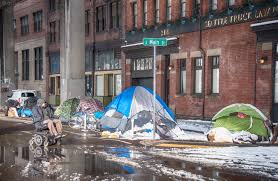
House Homeless People, First! Vote “No” on Seattle Propositions 1A & 1B

There are over 16,000 homeless people in King County. (Photo by Gillfoto, Wikipedia Commons)

Social Housing Propositions Focus on Wrong Population. Ballots were mailed Wednesday, January 22

By George Howland Jr. and Alice Woldt

Email: georgehowlandjr@gmail.com

January 24, 2025

On February 11, Seattle voters will be asked if the Seattle Social Housing Developer should receive millions of dollars in new taxes to construct or remodel mixed income, publicly owned and collectively managed apartment buildings.

The first question on your ballot will be, “Should either of these measures be enacted into law?” We urge you to vote “No.”

The second ballot question will be, “Regardless of whether you voted yes or no above, if one of these measures is enacted, which one should it be? Proposition 1A [or] Proposition 1B.” Neither is acceptable.

1.      Bad Policy. House homeless people, first! King County has over 16,000 homeless people. Public housing dollars should be used to helpthe poorest of the poor. Instead, House our Neighbors, the social housing advocates, want hundreds of millions of dollars to provide housing for mostly middle and working-class people. If Proposition 1A passes, House Our Neighbors projects that, in the first ten years, social housing will spend $500 million in new taxes to build or acquire 2,000 apartments but only 60 of them for homeless people. Relatively prosperous people will occupy 46 percent of social housing’s apartments. As single households, these are individuals who make between $84,000 and $126,000 a year. We have a real emergency of homelessness! It is simply bad public policy to use scarce tax money to house higher income groups.

2.      Bad Governance. Proposition 1A would send $52 million annually to the Seattle Social Housing Developer, created by a previous initiative, I-135.  Seven of its 13- member board must have “lived experience” as a poor renter or homeless person. When it comes to building low-income housing, we need professionals not well-meaning amateurs. None of the Board’s members are elected by the public. In its first two years of existence, the Board has shown itself to be more concerned with its members’ privacy than informing the public about its activities. The Board refuses to record its meetings, does not provide contact information for its members and is unresponsive to inquiries from the public.

3.      Bad Financing. Seattle’s housing levies that build apartments for homeless and very poor people have a sunset date. For instance, in 2022, Seattle voters approved a housing levy that will mainly build apartments to house homeless people and will raise $970 million over the next seven years. At that point, in 2030, politicians will have to come back to the voters and ask for more money. This allows us to hold them accountable. If Seattle City Hall doesn’t do a good job with the $970 million, we can choose not to give them any more money. In contrast, the approval of Proposition 1A will establish $50 million in new annual taxes that will continue in perpetuity—in other words, forever. It doesn’t matter if the social housing folks crash and burn, the tax money just keeps on flowing to them. This is an unacceptable way to finance expensive, experimental housing projects. 

Please vote “No” and don’t give any public money to this unelected, inexperienced and inaccessible organization, the Seattle Social Housing Developer.

Propositions 1A & 1B are risks that Seattle cannot afford.

George Howland, Jr. and Alice Woldt are members of the No Committee on Propositions 1A & 1B. Howland is a retired journalist who was an editor and reporter at The Stranger, Seattle Weekly and Real Change. Woldt is a retired executive from Fix Democracy First and Faith Action Network.

A Dog’s Breakfast Election

Seattle districts 2

District elections have brought change, but it’s unclear what kind

NEWS ANALYSIS

By George Howland Jr.

On Nov. 5, there were seven Seattle City Council district seats up for election. Election night returns indicate that the labor/lefty coalition won four seats and the Chamber of Commerce slate won two seats. In District 5 (North Seattle), incumbent councilmember Deborah Juarez was endorsed by both the Chamber and the labor/lefty coalition.

If these results hold, it will be a major repudiation of the business community’s $4 million (with Amazon contributing $1.4 million) effort to make the city council more conservative.

Yet given the political positions taken by the apparent winners, it is unclear what the new city council’s direction will be on key issues such as homelessness, displacement, growth and tax and wealth inequality.

Let’s look at the districts one by one.

District No. 1 (West Seattle, South Park)

Incumbent Lisa Herbold held a small lead on election night 51-48 percent over a weak challenger Phil Tavel. In the August primary, C is for Crank’s Erica C. Barnett reports that Herbold increased her lead by 4.2 percent from election night to final results. Herbold looks safe.

Herbold is a neighborhood progressive, very much in the mold of former Seattle City Councilmember Nick Licata, her mentor. Earlier this year, Herbold introduced the most important anti-displacement legislation in decades: a one-for-one replacement requirement that any low-income housing that is destroyed by redevelopment must be replaced by the builder. The future of the proposal is, however, gloomy because of legal issues and a lack of support from other councilmembers.

Continue reading “A Dog’s Breakfast Election”

Tammy Morales: An organizer for economic justice

In the election for Seattle City Council District Two, the favorite prioritizes stopping displacement

Morales 1
As a child, Morales experienced housing insecurity


POLITICS

By George Howland Jr.

Tammy Morales is Mexican American by birth, Jewish by choice and an organizer by vocation.

The Seattle City Council candidate for District Two (Rainier Valley, Beacon Hill, Chinatown International District) grew up poor in San Antonio, Texas. For the last 20 years, Morales, 50, has organized for economic justice in Seattle’s south end. Now she hopes to bring her perspective to city hall.

She won August’s seven-candidate primary with a whopping 50 percent of the vote—the kind of numbers that are usually reserved for incumbents. In Nov. 5th’s general election, she is facing off against Mark Solomon, 59, a crime-prevention coordinator for the Seattle Police Department. Solomon only won 25 percent of the primary vote, despite conservative and corporate groups spending over $100,000 to support him.

It’s very likely Morales will be celebrating on election night. If so, Morales would become the third Latinx woman on the nine-member city council in a city with a Latinx population of only 6.6 percent. Morales would be serving with sitting city council members Lorena Gonzalez and Teresa Mosqueda.

Morales says, “I do identify as Mexican American, not as Latinx.” She explains that it is probably her age that makes her prefer the former term. “It is part of who I am,” she says. Both of her parents are Mexican American, but she grew up living with her mother in a single-parent household. “I did not grow up speaking Spanish. I grew up hearing it. It was what the old folks spoke when they didn’t want us kids to understand.” She remembers sitting under her grandmother’s dining-room table, listening to the adults talking Spanish and trying to make out some juicy tidbits of gossip.

Continue reading “Tammy Morales: An organizer for economic justice”