House Homeless People, First! Vote “No” on Seattle Propositions 1A & 1B

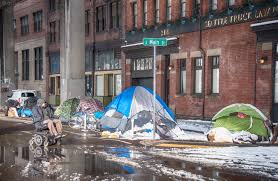
There are over 16,000 homeless people in King County. (Photo by Gillfoto, Wikipedia Commons)

Social Housing Propositions Focus on Wrong Population. Ballots were mailed Wednesday, January 22

By George Howland Jr. and Alice Woldt

Email: georgehowlandjr@gmail.com

January 24, 2025

On February 11, Seattle voters will be asked if the Seattle Social Housing Developer should receive millions of dollars in new taxes to construct or remodel mixed income, publicly owned and collectively managed apartment buildings.

The first question on your ballot will be, “Should either of these measures be enacted into law?” We urge you to vote “No.”

The second ballot question will be, “Regardless of whether you voted yes or no above, if one of these measures is enacted, which one should it be? Proposition 1A [or] Proposition 1B.” Neither is acceptable.

1.      Bad Policy. House homeless people, first! King County has over 16,000 homeless people. Public housing dollars should be used to helpthe poorest of the poor. Instead, House our Neighbors, the social housing advocates, want hundreds of millions of dollars to provide housing for mostly middle and working-class people. If Proposition 1A passes, House Our Neighbors projects that, in the first ten years, social housing will spend $500 million in new taxes to build or acquire 2,000 apartments but only 60 of them for homeless people. Relatively prosperous people will occupy 46 percent of social housing’s apartments. As single households, these are individuals who make between $84,000 and $126,000 a year. We have a real emergency of homelessness! It is simply bad public policy to use scarce tax money to house higher income groups.

2.      Bad Governance. Proposition 1A would send $52 million annually to the Seattle Social Housing Developer, created by a previous initiative, I-135.  Seven of its 13- member board must have “lived experience” as a poor renter or homeless person. When it comes to building low-income housing, we need professionals not well-meaning amateurs. None of the Board’s members are elected by the public. In its first two years of existence, the Board has shown itself to be more concerned with its members’ privacy than informing the public about its activities. The Board refuses to record its meetings, does not provide contact information for its members and is unresponsive to inquiries from the public.

3.      Bad Financing. Seattle’s housing levies that build apartments for homeless and very poor people have a sunset date. For instance, in 2022, Seattle voters approved a housing levy that will mainly build apartments to house homeless people and will raise $970 million over the next seven years. At that point, in 2030, politicians will have to come back to the voters and ask for more money. This allows us to hold them accountable. If Seattle City Hall doesn’t do a good job with the $970 million, we can choose not to give them any more money. In contrast, the approval of Proposition 1A will establish $50 million in new annual taxes that will continue in perpetuity—in other words, forever. It doesn’t matter if the social housing folks crash and burn, the tax money just keeps on flowing to them. This is an unacceptable way to finance expensive, experimental housing projects. 

Please vote “No” and don’t give any public money to this unelected, inexperienced and inaccessible organization, the Seattle Social Housing Developer.

Propositions 1A & 1B are risks that Seattle cannot afford.

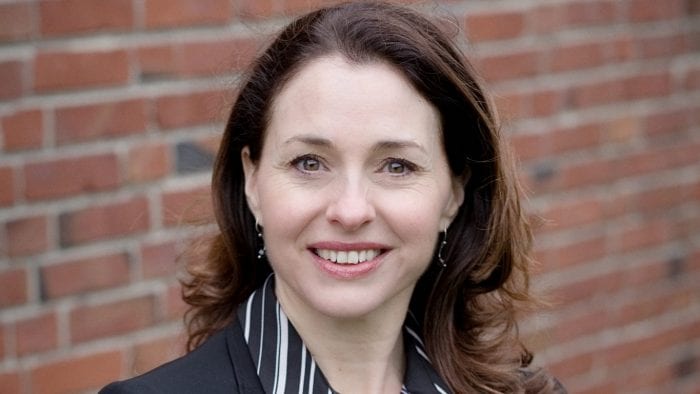
George Howland, Jr. and Alice Woldt are members of the No Committee on Propositions 1A & 1B. Howland is a retired journalist who was an editor and reporter at The Stranger, Seattle Weekly and Real Change. Woldt is a retired executive from Fix Democracy First and Faith Action Network.

Sound Transit wants to Install AI Cameras

Link light rail stations and garages would use new surveillance equipment

NEWS

By George Howland Jr.

In the first quarter of the next year, Sound Transit security staff will ask the Sound Transit Board of Directors to take the first step in installing artificial intelligence (AI) cameras throughout its Link light rail system of stations and garages. The Sound Transit Board of Directors will be asked to approve a Request for Proposals (RFP) from private vendors for the initial $979,200 purchase of the AI technology. There are no public meetings or public outreach planned in connection with this decision, according to John Gallagher, Sound Transit spokesperson. Branden Porter, Sound Transit’s System Security Manager, states the objective of the AI cameras is to save over $1 million per year in security costs. Sound Transit’s Gallagher stresses, “We’re not using these [cameras] in any way for facial recognition.”

Critics are not mollified by the promise. Shankar Narayan, Technology and Liberty Project Director for the American Civil Liberties Union of Washington (ACLU-WA), says, the use of AI cameras would force “people to choose between privacy and transit.” This controversy comes on the heels of Sound Transit, last month, releasing data that shows its fare enforcement results in disproportionate citations for African Americans (first reported by Erica C. Barnett and then The Seattle Times).

Voters in a tri-county region (roughly approximating King, Snohomish and Pierce counties) have approved an ambitious expansion plan of Sound Transit’s light-rail, express-bus and heavy-rail transit services. Sound Transit’s current light rail is 22 miles long and runs from the University of Washington’s Husky Stadium to Angle Lake, just south of Sea-Tac Airport. By 2041, Sound Transit plans to expand light raid north to Everett, south to the Tacoma Dome and east to Issaquah. There are also two planned expansions in the city of Seattle itself: one to West Seattle and the other to Ballard. Recently, statewide voter approval of Initiative 976 put Sound Transit’s funding into doubt. Currently, I-976 is facing a court challenge.

Continue reading “Sound Transit wants to Install AI Cameras”

A punch against the gays

One summer night in Wallingford, near Dick’s drive-in

Blossom Boys
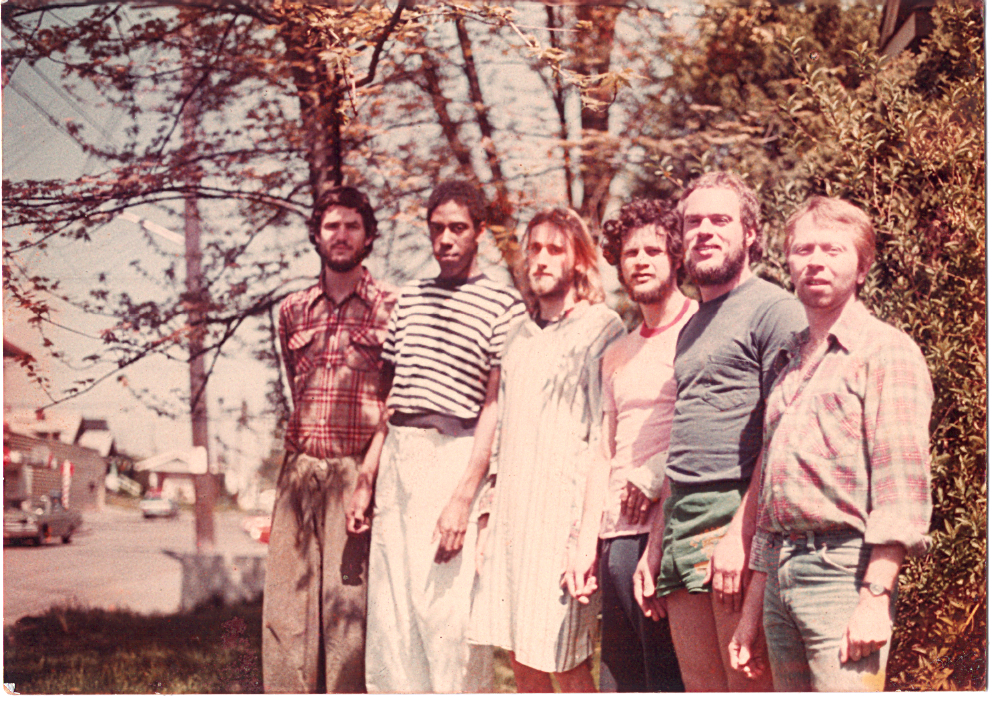
Members of Camp Blossom for Boys:  I am third from the left with long hair and a beard

MEMOIR

By George Howland Jr.

My boyfriend, Tommy, and I walked with arms around one another to the bus stop. It was the summer of 1979 and he was working graveyard at a print shop. We both had long hair and beards. My hair was blonde, and my beard was black; all his hair was brown. Both of us were way skinny. He wore jeans, a t-shirt and boots. I had on draw-string pants, a t-shirt and Birkenstock sandals with no back strap.

We were on North 45th Street, a main drag through Seattle’s Wallingford neighborhood, at the time a neighborhood of overwhelmingly white middle-class and working-class people.

I was living right up the street at Camp Blossom for Boys, an intentional community for gay, bi-sexual and straight men. I had spent 18 months putting Camp Blossom together as part of my effort to “fight the patriarchy” by changing men. Seven of us had rented a suburban looking house next to a gas station on First Avenue Northeast. Four gay men, two straight guys and me—the lone bisexual. Three of us were anarchists, one was an activist skeptic and the other three were gay guys who were curious about living with other men.

At the time, you didn’t see many gay couples in Wallingford. We didn’t care. We were proudly, militantly out.

I wore dangling earrings and androgynous clothing. The more stares I drew, the better. I wanted to confront people’s homophobia. I told everyone—my school district employer, my alternative public high school students, people that I met—that I was bisexual. The confrontations took their toll—my stomach was often convulsed with cramps.

Continue reading “A punch against the gays”

Heidi Wills and Strippergate

City council candidate (District 6) and former city councilmember takes responsibility for her past mistakes

Heidi Wills 2


NEWS

By George Howland Jr.

Heidi Wills rang my doorbell.

Earlier this summer, I put up a Facebook post about Wills and Strippergate–a City Hall scandal involving illegal lobbying and political money laundering by Frank Colacurcio, a vicious gangster. Wills, who served one four-year term, 2000-03, as an at-large city councilmember, is currently running for city council in District 6 (Ballard, Fremont, Greenwood). On Nov. 5, in the general election, she will face off against Dan Strauss, a former aide to City Councilmember Sally Bagshaw. Strauss won the primary election 34 percent to Wills’ 21 percent.

In 2003, Strippergate was partially responsible for Wills losing her city council seat to David Della. In this summer’s Facebook post, I wrote, “I have never heard Wills adequately explain her behavior and demonstrate that her judgment has improved. To me, this is a necessary step before serving on the council for a second time. “

That same night, Wills was in my Phinney Ridge neighborhood ringing doorbells (at publication time, she says she had personally contacted 6,500 households). Wills’ social media person telephoned her to raise the alarm about my post. Wills decided to come over to my house–she had the address as part of publicly available voter lists–and answer my questions. Over a cup of tea, in my fortunately clean kitchen, we talked about her political past and how it relates to the present campaign.

Continue reading “Heidi Wills and Strippergate”

Memories of a Luddite, Pt. 1

Deran Ludd, writer and activist, 1959-2018

deran
Ludd riffing on his choroideremia — a degenerative eye disease (Anonymous)

MEMOIR

by George Howland Jr.

A friend called with the sad news: Writer and activist Deran Ludd had committed suicide on September 9, 2018.

I only saw Deran dance once. It was 1977. Deran was frugging and laughing with Leslie Batchelder to the sounds of the B-52s “Rock Lobster.” The two of them were impossibly beautiful.

Deran had the delicate patrician features of the WASP elite. His hair was a little shaggy and he had on earrings that matched his blue eyes. His slim body didn’t hold my attention, it was his gorgeous face that I couldn’t stop looking at. My gaydar went off—but quietly. He seemed like a sweet, hippie boy.

Continue reading “Memories of a Luddite, Pt. 1”